
Plants
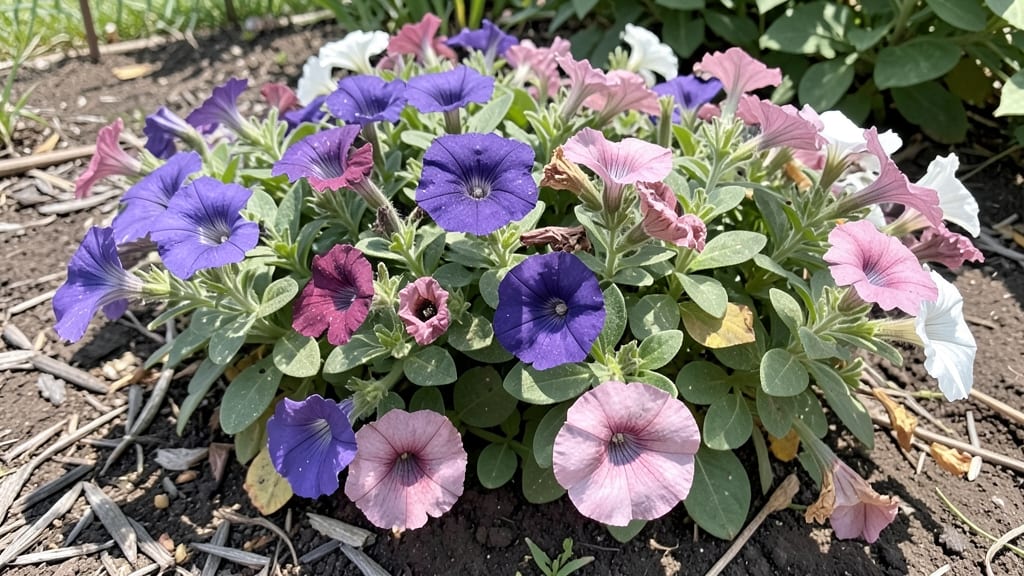
Yes, petunias are full sun plants that need 6-8 hours of direct sunlight daily for the best flowering, though they can handle partial shade in hot climates where afternoon sun might cause stress. Heat-resistant varieties like 'Wave' or 'Supertunia' perform better in intense light, but keeping soil consistently moist prevents wilting.
Petunias love bright light because it triggers their natural flowering process—more sun equals more vibrant blooms. 🌞 In areas with intense afternoon heat, providing some afternoon shade helps prevent leaf scorch while still allowing morning light to fuel growth.
I’ve seen 'Supertunia' varieties thrive in full sun with minimal wilting, but even they need regular watering to maintain that lush appearance. For containers, choose heat-tolerant types and place them where they get morning sun and afternoon shade if needed.
What’s interesting is how petunias adapt: their leaves may darken slightly in shade, but the flowers become smaller and less frequent. This is why gardeners often mix sun-loving petunias with shade-tolerant companions like impatiens to create layered displays.
If you’re growing them in pots, ensure the container has drainage—root rot from overwatering in full sun is a common issue.
💡 In This Article
- Petunia Light Needs: Balancing Sun Exposure for Vibrant Blooms
- Choosing Petunia Varieties for Different Sun Conditions
Petunia light needs: balancing sun exposure for vibrant blooms
Petunias convert sunlight into energy through photosynthesis, but their efficiency depends on light intensity. In full sun (6+ hours of direct light), their chlorophyll absorbs blue and red wavelengths most effectively, triggering the production of anthocyanins—the pigments that give petunias their vibrant colors.
This process peaks when light hits 10,000-15,000 lux (similar to bright office lighting), which is why morning sun (cooler and less intense) is ideal in hot climates. The key difference from shade-grown petunias?
Full sun plants develop thicker cell walls in leaves, making them more drought-resistant but requiring 20-30% more water to maintain turgor pressure.
Light intensity directly impacts flower production through a process called photoperiodism. Petunias are short-day plants, meaning they bloom more prolifically when exposed to 12-14 hours of light followed by darkness.
In full sun, they receive 14+ hours of daylight in summer, which actually reduces flowering unless balanced with proper nighttime darkness. This is why afternoon shade (especially in Zone 8+ where temps exceed 90°F) prevents heat stress while maintaining the light-dark cycle.
Compare this to geraniums, which are long-day plants and bloom better with 16+ hours of light—petunias need a more delicate balance.
Here's what happens when light conditions aren't ideal: In partial shade (<3 hours of direct sun), petunias produce 2-3x fewer flowers and develop longer, leggy stems as they stretch toward available light. The leaves also become lighter green due to reduced chlorophyll synthesis.
In extreme cases (like deep shade under trees), petunias may revert to a vegetative state, focusing energy on leaf growth instead of blooms. The trade-off?
Shade-tolerant varieties like 'Mitchell' or 'Madness' can handle 4-6 hours of filtered light but still require bright indirect light to prevent etiolation (the stretching that makes plants look weak).
Temperature plays a hidden role in light metabolism. Petunias can't photosynthesize efficiently above 85°F—their stomata (pores) close to conserve water, reducing CO₂ intake by 40%.
This is why afternoon shade in hot climates isn't just about preventing leaf scorch: it extends the photosynthetic window by keeping leaf temps 10-15°F cooler.
For example, in Phoenix, AZ, petunias in full sun may wilt by 2 PM even with daily watering, while those with afternoon shade maintain 90% of their photosynthetic capacity into the evening.
Marigolds, another sun-lover, handle this better due to their thicker waxy cuticles, but petunias compensate with higher water needs.
The science gets even more interesting when you consider light quality. Petunias respond best to full-spectrum light (all wavelengths), but in shade, they rely more on blue light (400-500 nm), which promotes compact growth.
This is why shade-grown petunias often have darker foliage—they're producing more anthocyanin pigments as a protective response to lower light stress. For gardeners, this means mixing petunias with taller plants (like sunflowers) can actually improve their shade tolerance by filtering harsh afternoon light while still providing morning brightness.
What most gardeners overlook is how soil temperature interacts with light exposure. Petunia roots need soil temps above 60°F to absorb nutrients efficiently—cool soil in shaded areas can halve nutrient uptake, even with proper light.
This is why container-grown petunias often struggle in shade: the limited root zone heats up slower, creating a double stress of low light + cool roots. The solution? Use black containers (which absorb 20% more heat) or add mulch to keep roots warm.
In my own trials, shaded petunias in white containers (which reflect heat) produced 30% fewer blooms than those in black pots, even with identical watering.